Reflections on a Proof of Concept with Municipalities, User Associations, and GLBNXT

Public procurement forms an essential yet complex part of municipal operations. It demands careful consideration across legal, financial, and organizational dimensions, with transparency, lawfulness, and accountability at its core. At the same time, municipalities face the challenge of making their working processes future-proof, in a context where digitalization and AI are advancing rapidly.
The question is no longer whether generative AI is relevant to the procurement domain, but rather under what conditions and with what added value. That question cannot be answered through abstract models or policy frameworks alone, it requires practical experience, reflection, and shared insights.
Why This Proof of Concept?
curement is a core process within municipalities. It is legally sensitive, procedurally complex, and rich in documentation. At the same time, it is a domain where patterns, repetition, and recurring themes play a major role, which makes it interesting for AI applications, but also challenging.
The intention of the commissioning parties was explicitly not to automate processes or replace people, but to give civil servants a safe and realistic opportunity to gain experience with AI. The proof of concept was designed to investigate whether and where AI can provide support within the procurement domain, both in day-to-day execution and at the procedural level. Three central questions guided the work: how do civil servants experience working with AI; to what extent can AI genuinely assist with procurement; and which procedural bottlenecks in the procurement process as a whole might become more transparent or manageable with the help of AI.
To stay as close to practice as possible, the PoC was shaped within the existing procurement framework, using real procurement cases from TenderNed. This PoC was offered entirely free of charge to user association members for the full year of 2025.
The Setup: A Data-Driven AI Environment for Procurement
For this proof of concept, GLBNXT built a generative AI environment directly connected to TenderNed. Through this integration, both all historical procurement records from 2022 onwards and a continuous, real-time stream of new procurement documents were made available within the GLBNXT platform. In practice, this means that each procurement case contains an average of approximately 20 documents. These documents vary widely in format and content, and include PDF, Word, and Excel files as well as visual materials. Together, they form the complete context of a procurement case, as used by both municipalities and suppliers.
Examples of documents made accessible within the environment include:
Procurement announcements
Tender guidelines and procurement documents
Notes of Clarification
Requirements specifications (Programma van Eisen)
Draft agreements
Data processing agreements and privacy annexes
Pricing forms and calculation tables
Selection and award criteria
Annexes, explanations, and supplementary instructions
At the time of the PoC, this represented a dynamic dataset of approximately 800,000 individual documents, continuously growing as new procurement cases were published on TenderNed. This scale and variety made the procurement domain exceptionally well-suited for an exploratory AI application, while simultaneously highlighting the complexity of working with unstructured and diverse information sources.
Operational Support: AI as TenderAnalyst
Making a dataset of approximately 800,000 procurement documents available within a generative AI environment does not, in itself, constitute a workable solution for procurement specialists. Without structure, context, and a recognizable interaction model, such an environment remains complex and difficult to apply in daily practice.
For this reason, GLBNXT made a deliberate choice to provide an accessible and familiar user experience. As a specialist in sovereign and open-source AI applications, the Open WebUI frontend was used. This interface closely resembles the experience many civil servants already have with generative AI tools such as ChatGPT or Microsoft Copilot, and is already in use by several municipalities as their AI frontend.
Within this environment, the TenderAnalyst was introduced: a specialized AI agent supporting procurement specialists in working with one concrete procurement case at a time. This brought the vast dataset down to a manageable, context-focused working environment, where civil servants could search, analyze, and explore naturally, without needing to first acquire technical knowledge or learn new tooling.
Civil servants were able to, among other things:
Analyze historical and current procurement documents by asking questions across multiple documents in plain, natural language, something that would be practically impossible or extremely time-consuming without AI.
Generate summaries of extensive procurement dossiers, automatically drawing together relevant sections from different documents.
Rewrite and refine texts in an appropriate tone and structure, aligned with procurement guidelines and administrative context.
Ask targeted questions in natural language about specific topics, patterns, or recurring themes within procurement cases, without needing to search or filter at the document level beforehand.
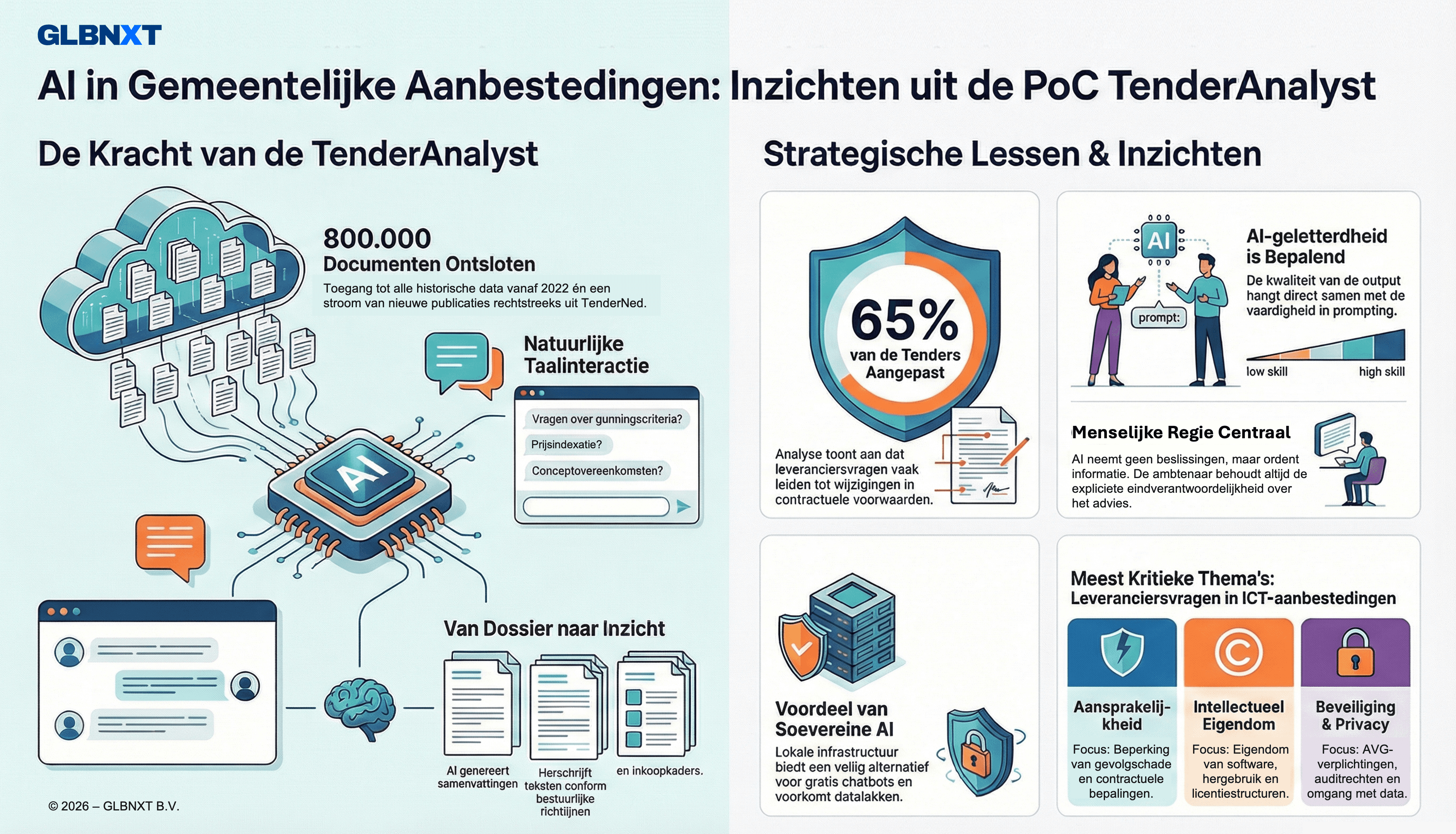
An important aspect of the positioning: the AI made no decisions, but supported users in organizing information and exploring options. In total, approximately 50 municipalities participated in the PoC, with an average of two users per municipality, while substantive responsibility always remained explicitly with the user. Examples of questions users put to the TenderAnalyst:
What are the award criteria?
Has a method for price indexation been established?
Write an improved version of the "requirements specification"
In practice, this yielded valuable first experiences. At the same time, it became clear that working effectively with AI is not self-evident. Formulating good questions, providing context, and evaluating results all require time and attention.
From Operational to Strategic: Looking Across Procurement Cases
Alongside this operational support, the PoC deliberately explored a second track: strategic and tactical questions at the level of multiple procurement cases simultaneously. Here, the focus was not on a single procurement dossier, but on questions such as:
Which articles most frequently give rise to discussion
Which themes in the GIBIT (standard ICT terms for government) structurally generate questions or objections from suppliers
Where possible ambiguities lie in the standard terms and conditions
By analyzing a larger set of procurement cases collectively, it became possible to surface patterns and trends. This type of analysis is difficult for people to perform manually, yet this is precisely where generative AI demonstrated its potential added value.
Insights from Supplier Questions in ICT Procurement
In addition to the operational pilot for individual civil servants, the PoC included an analysis of supplier questions in municipal ICT procurement. For this purpose, more than 600 procurement cases on TenderNed (CPV 48000000) from the years 2023–2025 were analyzed. Every question explicitly related to the ICT domain, and where possible traceable to a specific GIBIT article, was included.
The analysis shows that supplier questions structurally concentrate around a limited number of themes:
Contractual provisions and liability, questions about limiting liability and excluding consequential damages
Intellectual property and usage rights, discussion about ownership of developed software, reuse, and licenses
Service levels and maintenance, clarification of SLAs, response times, and penalties for breach
Security and privacy, GDPR obligations, audit rights, and the handling of personal data
Delivery, implementation, and transition, remediation periods, exit arrangements, and migration obligations
In addition, a portion of the questions could not be directly traced to the GIBIT. These concerned topics including interoperability, cloud standards, and AI-related governance, pointing to themes that are currently addressed only partially, or not at all, in the existing standard terms and conditions. The insights were shared with the commissioning parties as a factual reflection on recurring patterns, intended to support the conversation about possible improvements to procurement documents and standards, not as an automatic directive, but as substantiated input for policy considerations.
The Reality: Learning Takes Effort
The proof of concept made clear that effective use of AI does not happen automatically. AI literacy varies considerably between employees; skills such as formulating good prompts are decisive for the quality of outcomes.
"The rapid development of AI fundamentally influenced the outcome of the project. With the knowledge we have now, we would have structured the project differently and framed the questions in another way, which could have led to results that better matched our expectations. At the same time, working alongside GLBNXT made it a valuable and inspiring learning journey."
Theo TimmermansPolicy Advisor / Secretary, PinkRoccade Local Government User Association
Furthermore, the high pace of AI development demands in-depth knowledge of both the technology and the procurement domain. A meaningful assignment requires understanding both worlds simultaneously. It also became apparent that existing data structures are not always immediately suitable for generative AI and often require further development before they can be optimally utilized.
Finally, some participants expressed caution regarding AI. This hesitancy is understandable within a public sector context and underscores the importance of transparency, guidance, and a safe learning environment. Taken together, these insights confirm that AI adoption within municipalities requires time, direction, and realistic expectations, with space to learn without pressure for immediate results.
Learning Together: User Associations, Municipalities, and GLBNXT
What characterized this proof of concept was the open collaboration between parties with complementary domain expertise. The user associations played a connecting and framing role; municipalities contributed practical experience and critical reflection from within the procurement domain; and GLBNXT provided the platform, AI expertise, and guidance.
There was room to share successes, but also to be open about limitations and assumptions. It was precisely this combination of substantive knowledge and transparency that made it possible to learn collectively and place the experiment in its proper context.
The Value of This PoC - Beyond the End Result
After the agreed twelve-month run, the pilot was successfully concluded in good mutual agreement. Over this period, the proof of concept yielded concrete, transferable insights at multiple levels that point the way toward next steps.
Factual insights from procurement analyses The analyses carried out show that procurement cases in practice are less static than often assumed. It appears that in approximately 65% of the cases examined, one or more articles were modified in response to supplier questions, with a clear emphasis on liability, but also on payment terms and contract termination. These findings provide a factual basis for reflection on standard terms and recurring friction points in ICT procurement.
The importance of AI literacy The PoC made visible that AI literacy is a determining factor in the success of such a program. Varying levels of knowledge and experience, particularly around formulating good questions and interpreting outputs, have a direct impact on the value that can be extracted from AI applications. This underlines the importance of guidance and knowledge development alongside technological implementation.
Technology in motion Over the course of the PoC, it became clear how quickly generative AI is developing. In a period of approximately twelve months, notable advances were visible in the areas of:
• Long-context reasoning and retrieval-augmented generation (RAG)
• Advanced document parsing and semantic chunking
• Agent-based architectures with task decomposition
• Model stability, determinism, and evaluation mechanisms
This underlines that AI experiments are by definition snapshots in time and require flexibility in expectations, scope, and assessment.Value beyond the end product The return on this PoC therefore lies not in a finished product, but in experience, insight, and realistic expectations. It is precisely these elements that form a solid foundation for next steps, both within municipalities and among suppliers, and contribute to a mature and responsible conversation about the use of AI in public procurement.
"The joint AI initiative by GLBNXT and the user associations was positively received by municipalities within GV Centric. Interested in the possible applications of AI for their organizations, many municipalities registered with multiple participants. In practice, working with the AI tool proved more challenging than expected. Staff discovered that effectively deploying AI in municipal operations takes time and practice.
This experience, though sometimes frustrating, was instructive. All in all, participants look back on the PoC with a good feeling. They have found their footing in the world of AI and can see more clearly where it does and does not fit into their work. The pilot brought municipalities back down to earth: AI offers opportunities, but also demands a realistic approach."
Sacha Heijkoop
Advisor, Information Management and Data in the Public Sector, GV Centric
Looking Ahead: Sovereign AI as a Mature Choice
The proof of concept took place during a year in which cloud, data sovereignty, and AI were prominent topics of discussion, both within the industry and across the Dutch governmental landscape. In 2025, the Dutch Data Protection Authority (Autoriteit Persoonsgegevens) received dozens of reports of data breaches caused by the use of AI chatbots in the workplace. The number of reports this year is higher than the year before, with free versions of chatbots in particular causing problems. Municipalities have also been affected.
Against this backdrop, GLBNXT chose to build a platform on its own infrastructure, with no dependency on hyperscalers, in which AI applications can be offered in a fully sovereign manner. As part of the PoC, participants were provided access to an EU AI Agent that ran locally on the Dutch GLBNXT platform. This agent was offered at no additional cost to demonstrate that a 100% sovereign AI solution can be fully competitive in both performance and user experience. The positive reception and active use of this agent demonstrate that sovereign AI now represents a practical and workable alternative to public cloud AI services within the public sector.
Acknowledgements
Our thanks go to the user associations, the participating municipalities, and all civil servants who invested their time and energy in this proof of concept. This program was not an endpoint, but an important point of learning, and with that, a valuable step in the continued exploration of responsible, sovereign AI within government.
References
Autoriteit Persoonsgegevens: meer datalekken door ongeoorloofd gebruik gratis chatbots
Procurement efficiency: A modern strategy for state and local leaders
Digitale overheid - wat je moet weten over ai geletterdheid
Gartner - ai faalt vaak niet door model maar door gebrek ai ready data
© 2026 GLBNXT B.V. All rights reserved. Unauthorized use or duplication is prohibited.
