Resources center

All blog posts

AI and the end of the billable hour
How consultancies can scale with AI without leaking client trust
AI is breaking the billable hour. Consultancies that want to sell expertise, not time, need AI they can defend in front of a client: traceable, EU-hosted, and never trained on client data.

AI guardrails: the difference between a policy and a control
Safe AI at work is something you can inspect. Here is what to check before your employees rely on it, and what to ask any vendor.
Your company has an AI platform, and soon everyone will use it every day. They will paste contracts into it, ask it about customers, and sooner or later someone will ask it what a colleague earns. How smart the model is will not decide whether this goes well. What decides it is what stops the model from doing something your company will regret.

Sovereignty Washing
Everyone's Saying It, Nobody's Defining It
Open almost any technology vendor deck right now and you'll meet the word before the third slide. Sovereign cloud. Sovereign AI. Sovereign by design. It's printed on booth banners, baked into press releases, sitting halfway down every other product page. And somewhere in all that repetition, it quietly stopped meaning anything.
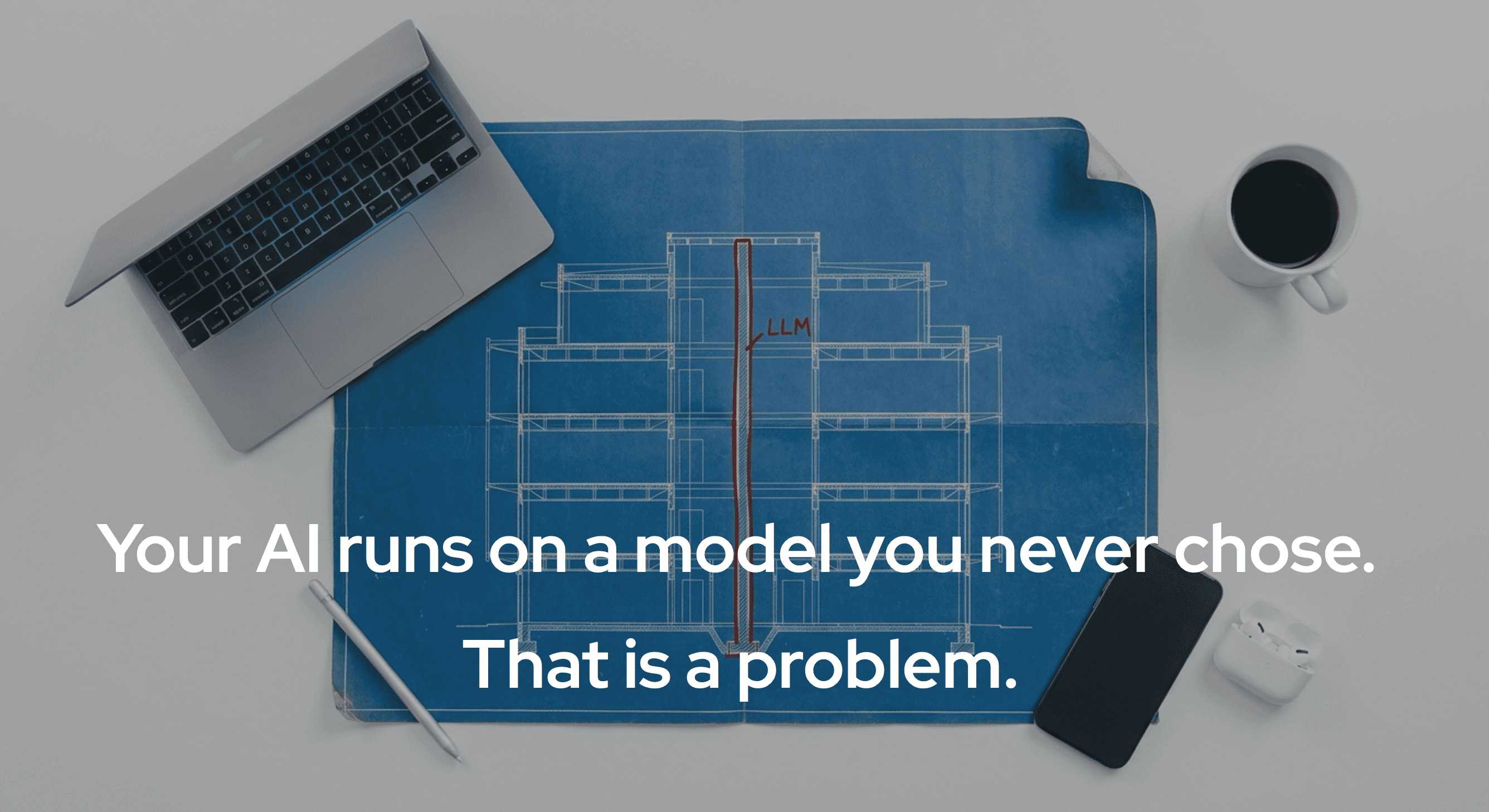
Your AI runs on a model you never chose. That is a problem.
A practical guide for business leaders navigating model choice, vendor lock-in, and regulatory exposure
There is a conversation happening in boardrooms across Europe right now, and it tends to follow the same pattern. A CIO describes how their organisation adopted an AI platform twelve months ago. It worked well. The use cases expanded. Then someone in legal asked a question that nobody had thought to ask at the start: where does the model actually process our data?

Your AI Vendor Passed the Security Audit. But Did Anyone Check the Model?
How the OWASP Top 10 for LLM Applications gives procurement teams the language they have been missing
Procurement teams in regulated organisations have spent years getting good at evaluating cloud vendors. They know how to read a SOC 2 report. They know what to look for in a Data Processing Agreement. They can spot a vague sub-processor clause at fifty paces. None of that prepares them for what happens when the product being procured is an AI system built on a large language model.
Why ChatGPT Is Not GDPR-Compliant ,And What That Means for Executives
Training data, prompt flows, the CLOUD Act, and rights that can't be served: a plain-language walk through the mechanics underneath the headline.
The question comes back around the boardroom table every few months. Someone read an article. Someone heard the Italian regulator made noise again. Legal sent a cautious email. And the answer that gets passed back up the chain is usually some version of “we bought the enterprise plan, we have a DPA, we’re fine.”

Responsible AI demands clear European choices
A conversation with co-founder Jan Saan on platform building, compliance by design and starting small
Europe isn’t short on AI capacity, but it clearly is short on control. While hyperscalers and ‘GPT wrappers’ (applications built on top of the OpenAI-GPT API) promise the moon, organisations are wrestling with a hard reality: how do you deploy AI without handing over your data, your control, or your pace? The answer is a European platform that combines speed, sovereignty and scalability - without the usual IT complexity. Because who still wants to spend years experimenting while the competition is already winning?

Vendor lock AI
The contract clauses nobody's negotiating (but should be)
We see this pattern a lot. A company signs an AI vendor contract. It has the usual suspects: a data processing addendum, an SLA with uptime numbers, maybe a GDPR clause bolted on. The legal team signs off. IT is happy. Everyone moves on. Then something shifts. The vendor bumps pricing by 30%. Or they quietly swap the model running behind the API, and suddenly your validated workflows produce different outputs. Or worse, the vendor gets acquired, and the new owner has different ideas about data retention.

AI Sovereignty 101
What It Is and Why Every Enterprise Should Care in 2026
Imagine this: a mid-sized law firm in Frankfurt adopts a popular AI assistant to speed up contract review. The tool works beautifully. Response times drop, associates handle more matters, and clients are impressed. Six months in, a partner asks a simple question: where exactly is our client data being processed? The answer, it turns out, isn't straightforward, and the implications run deeper than anyone expected.

Why Public Sector Advisors Choose 100% EU-Hosted AI
Case Study: Haute Equipe Tests Sovereign AI in a Proof of Concept with GLBNXT
In the landscape of public sector consulting, Haute Equipe is well known for their expertise in business operations, legal advisory, and the social domain. But like many advisory firms in the public sector, Haute Equipe wrestles with a fundamental question: how can we use AI without sharing sensitive government information with American tech giants?

Learning Together About AI in Public Procurement
Reflections on a Proof of Concept with Municipalities, User Associations, and GLBNXT
This article presents the findings of a proof of concept in which the User Associations of PinkRoccade Local Government and Centric, together with GLBNXT, jointly explored how generative AI can be used to support procurement processes for Dutch municipalities. Not with the goal of automating processes, but to understand where AI can help, where its limits lie, and what preconditions are essential for responsible use within the public sector.

The Case for Sovereign AI in Legal Practice in 2026
How Dutch Law Firms Can Embrace Technology Without Compromising Client Confidentiality
The legal profession is at an interesting crossroads right now. Artificial intelligence, particularly generative AI, promises to change how lawyers work. We're talking about everything from legal research and document analysis to drafting and client communication. But this technological leap raises some critical questions about professional obligations, client confidentiality, and the independence of legal practice itself.

Unlocking the Potential of AI in Healthcare
The Role of AI-Powered Language Models in Modern Healthcare
AI-driven language models are fast being included into healthcare, providing fresh opportunities to increase operational efficiency and patient care. Improved large language models (LLMs) during the past year have opened the path for better clinical applications, therefore enabling healthcare providers to work more effectively.

Sovereign AI in the Age of Compliance
A Guide to Building Privacy-First AI Solutions with GLBNXT
Artificial Intelligence is no longer the future—it's the present. But as AI technologies rapidly transform how businesses operate, a critical challenge emerges: how can enterprises fully leverage the power of AI while remaining aligned with the strictest data protection standards? If your organization is committed to innovation, but not at the expense of trust, transparency, or control, this blog is your starting point.

Beyond Data Residency The Multi-Dimensional Reality of AI Sovereignty
The Multi-Dimensional Reality of AI Sovereignty
Most enterprises have sovereignty backwards. They invest in regional data centers, negotiate compliance contracts, and ensure geographic residency, then hand complete control of their AI orchestration layer to vendors. The result? Organizations that are compliant but not sovereign. According to Gartner's 2026 CIO Survey, 50% of technology executives worldwide now recognize this gap and are re-evaluating vendor relationships. True sovereignty lives at the orchestration layer, the routing logic, model selection, fallback strategies, and integration patterns that determine your architectural flexibility.
