The contract clauses nobody's negotiating (but should be)

We see this pattern a lot. A company signs an AI vendor contract. It has the usual suspects: a data processing addendum, an SLA with uptime numbers, maybe a GDPR clause bolted on. The legal team signs off. IT is happy. Everyone moves on.
Then something shifts. The vendor bumps pricing by 30%. Or they quietly swap the model running behind the API, and suddenly your validated workflows produce different outputs. Or worse, the vendor gets acquired, and the new owner has different ideas about data retention. You pull out the contract to check your options, and you find that your exit clause is three sentences long. It says you can leave with 90 days notice. It says nothing about what happens to your fine-tuned models, your prompt libraries, your retrieval pipelines, or the integration logic your team spent eight months building.
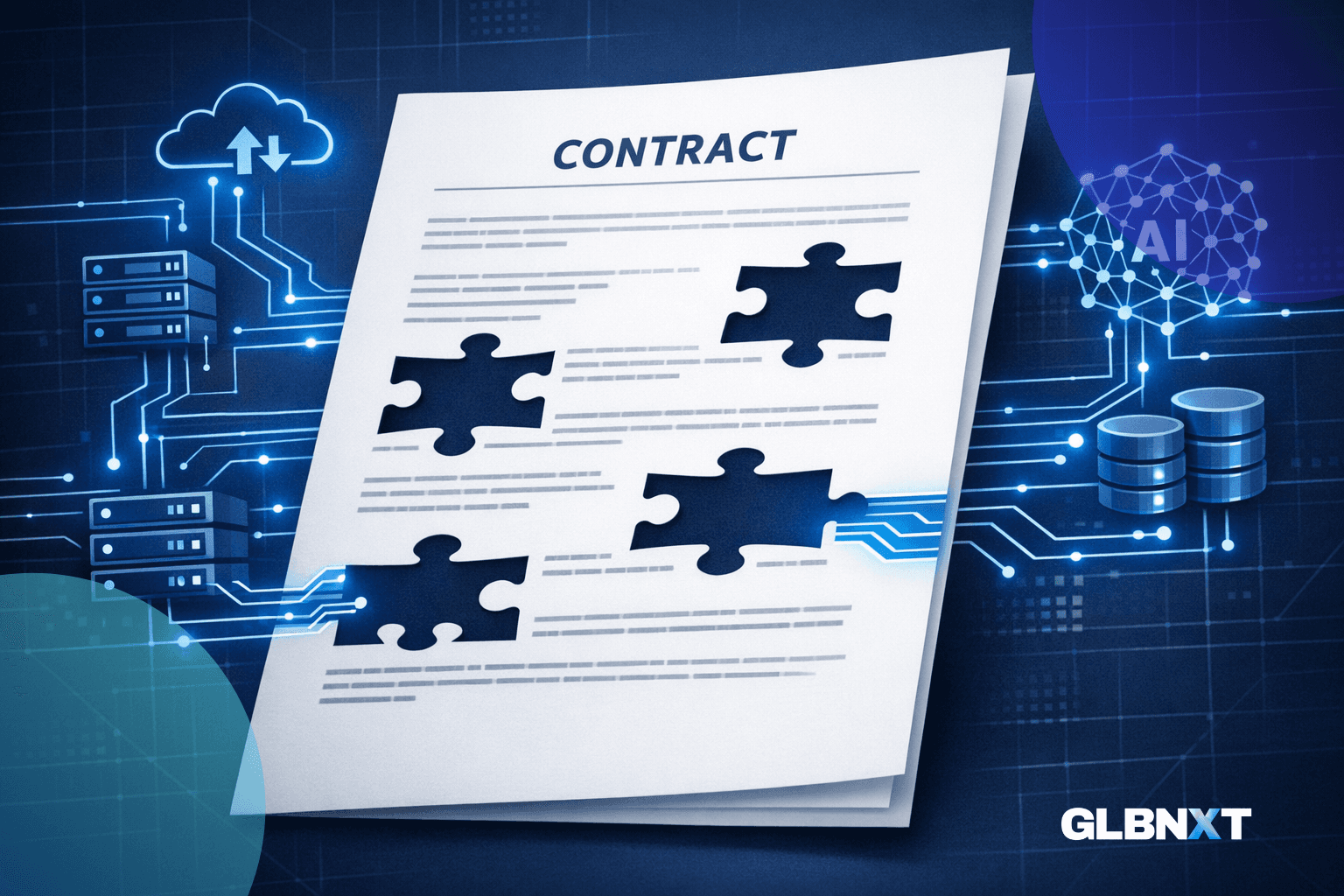
That gap between what the contract says and what it actually lets you do when you need to leave is what we call the vendor lock AI clause gap. And it's wider than most organizations realize.
Why old-school lock-in thinking falls short
If you've been around enterprise IT long enough, you've heard the playbook for avoiding vendor lock-in. Use multi-cloud. Avoid proprietary APIs. Negotiate egress fees upfront. Demand data portability.
That playbook was written for infrastructure. It doesn't work for AI.
AI lock-in runs deeper than compute and storage. When your team builds on a vendor's AI platform, the entanglement goes beyond the infrastructure layer. Your prompts contain institutional knowledge. Your embeddings encode how your organization understands its own data. Fine-tuning datasets reflect months of domain specific curation. Retrieval pipelines are tuned to your content structure. Workflow logic, evaluation benchmarks, output validation rules: all of it lives inside the vendor's environment, often in proprietary formats that don't travel well.
Then there's the versioning problem. AI vendors update models regularly, and they don't always tell you when they do it. Your outputs change. Validated processes break. If you're running AI assisted contract review for a law firm, or clinical decision support for a hospital, a silent model swap isn't a minor inconvenience. It's a compliance event. And your contract probably has no clause addressing it.
There's also the sub-processor chain to consider. Many AI vendors are, in practice, thin wrappers around larger providers. You contract with one company, but your data flows through two or three others, through cloud infrastructure you didn't choose, model hosting you weren't told about, logging services you've never heard of. Under GDPR, you need to know every entity processing personal data. Under the EU AI Act, you need traceability. Most DPAs weren't written with this kind of chain in mind.
We don't have to theorize about what happens when vendor dependency meets reality. Builder.ai, backed by Microsoft and the Qatar Investment Authority, collapsed in late 2024, leaving customers stranded without access to their own applications and data. In January 2025, a major ChatGPT outage disrupted GPT-4 and related models for hours, and organizations without model agnostic fallback architectures had no plan B. These aren't edge cases. They're signals.
Five gaps hiding in your AI vendor contract
Here's where it gets specific. After reviewing dozens of AI vendor agreements across regulated industries, we keep finding the same blind spots. These aren't theoretical risks. They're real gaps in real contracts, and most procurement teams don't know to ask about them.
Start with data training. Most AI vendor contracts don't explicitly prohibit the vendor from using your data to improve their models. The default assumption in many agreements is opt-out, not opt-in. Standard data processing addendums weren't designed to cover embeddings, fine-tuning datasets, or contextual data that gets processed through model inference pipelines. For organizations operating under GDPR or sector specific regulation, this isn't a nuance. It's an exposure.
Then there's model versioning. AI vendors can update, swap, or deprecate the underlying model powering your integration without giving you advance notice. If your AI workflow has been validated for a specific output profile (and if you're in a regulated industry, it should be), a model change can invalidate that validation overnight. We've seen almost no contracts that require the vendor to give advance notification of model changes, let alone concurrent access to old and new versions during a transition window.
Portability is another one. A lot of contracts include a line about data export. On paper, that sounds reassuring. In practice, it usually means you can download a CSV of your metadata or a log file. That's not portability. Real portability means you can export your prompts, your embeddings, your fine-tuned model weights, your retrieval indexes, and your workflow configurations in open, documented formats, and reconstruct your AI setup somewhere else. Almost nobody's contract guarantees that.
Sub-processor transparency is often missing entirely. Your AI vendor almost certainly relies on cloud infrastructure from AWS, Azure, or GCP, and may route data through additional third party model providers. Under GDPR Article 28, processors must inform controllers about sub-processors and give them the right to object. Under the EU AI Act, high risk AI systems require full traceability of the processing chain. In practice, most AI vendor contracts give you a static PDF list of sub-processors that was last updated six months ago. No mechanism to object when a new one shows up.
And finally, the exit clause itself. Even when there is one, it rarely covers what actually needs to happen during a transition. Fine-tuned models, accumulated evaluation data, integration configurations, workflow logic: all of it typically stays behind. Without a transition assistance clause that defines cooperation timelines, format requirements, and deletion certification, "leaving" means rebuilding from zero. In regulated sectors, rebuilding also means re-validating, re-documenting, and in some cases re-certifying your entire AI pipeline.
What we've seen in the field
During a project with a mid-sized Dutch financial services firm, we hit the data training gap head-on. They'd been running an AI powered document classification system through a US-based vendor for about a year. Everything looked fine until a routine DPIA review surfaced a question nobody could answer: was the vendor using their transaction data to train its general model? The contract was ambiguous. The DPA didn't address model training as a processing activity. It took three months to get clarity and an amended agreement. In the meantime, the firm had to flag the uncertainty to its regulator as a potential GDPR Article 5 issue. Fixable, but expensive in time and reputation.
The portability gap came up with a public sector advisory organization that wanted to switch AI providers after eighteen months. They asked for a data export and got a ZIP file with raw text and a query log. No embeddings, no retrieval configs, no prompt templates. The knowledge layer their team had spent over a year building wasn't exportable. Their contract technically allowed data export, but only covered inputs. Everything the system had learned about how to use that data stayed behind. Rebuilding from scratch: four to six months. We ended up designing a vendor neutral architecture layer with them so the next switch wouldn't carry the same cost.
Both cases were preventable with better contract language upfront. That's the frustrating part.
Regulatory pressure is building
The regulatory environment is moving faster than most AI contracts are. What was acceptable in 2024 probably won't hold up in 2027, and the pressure is coming from multiple directions at once.
The EU AI Act entered into force in August 2025, with full enforcement provisions kicking in from August 2026. For high-risk AI systems, the Act requires detailed documentation, traceability, and human oversight. If your vendor controls the model, updates it without notice, and won't disclose its sub-processor chain, meeting these requirements becomes very difficult. The contract has to do the work that regulation now demands.
The ongoing tension between GDPR and the US CLOUD Act hasn't gone away either. Data processed by US-headquartered cloud providers can still be subject to US government access requests, even when that data is hosted in the EU. For organizations in financial services, healthcare, legal, or public administration, that jurisdictional ambiguity is a compliance risk that needs explicit contractual coverage.
Even the US government is catching on. In March 2026, the GSA released a draft of GSAR 552.239-7001, a proposed contract clause for AI systems in government procurement. It requires data portability in open formats, advance notification of model changes, concurrent access to old and new model versions during transitions, and anti-lock-in provisions. If the US federal government thinks vendor lock AI is a procurement risk worth legislating, that should tell you something about the state of most private sector contracts.
For Dutch and EU-based organizations, the bar is higher still. The combination of GDPR, the AI Act, and sector specific rules means your AI contracts need to be airtight on data sovereignty, processing chain transparency, and exit rights. Most vendor standard terms don't come close.
What a better contract actually looks like
Nobody's asking for perfection here. But there's a minimum bar, and most AI contracts fall well below it. Here's what procurement and legal teams should be demanding as a baseline.
Any use of client data in model training needs to be explicitly opt-in, with clear definitions of what counts as "training data." Model changes that could affect outputs need at least a 60-day advance notification window, and the vendor should provide concurrent access to the old version during transition. Data export clauses need to go beyond raw inputs. They should cover prompts, embeddings, fine-tuned weights, retrieval indexes, evaluation benchmarks, and workflow configurations, all in open formats like JSON, Parquet, or ONNX. The sub-processor register should be live and maintained, updated within 14 days of any change, with a contractual right to object. Transition assistance needs defined timelines, cooperation obligations, format specifications, and deletion certification within 30 days of contract end. And jurisdictional control clauses should specify exactly where data is processed, stored, and accessible from.
None of this is exotic. It's the kind of contract language that already exists in mature IT procurement. AI procurement just hasn't caught up yet.
Closing the gap
The vendor lock AI clause gap is a solvable problem. But it requires organizations to treat AI procurement as a strategic function, not something that gets handled by copy-pasting the same MSA template you use for SaaS subscriptions.
The organizations that will have the easiest time adapting to the EU AI Act and navigating GDPR enforcement are the ones negotiating these clauses now, before they actually need to invoke them. Not after a vendor raises prices or swaps a model that breaks their workflow.
If you're already locked in, it's not too late. But it will cost more. The best time to close these gaps was before signing. The second best time is the next contract renewal.
About GLBNXT
GLBNXT provides sovereign AI solutions built for regulated industries. Our platform is 100% EU-hosted, GDPR-compliant by design, and built with zero training on client data. We work with legal practices, government advisory firms, and enterprises that need AI they can trust. To learn more or schedule a demonstration, visit www.glbnxt.com.
